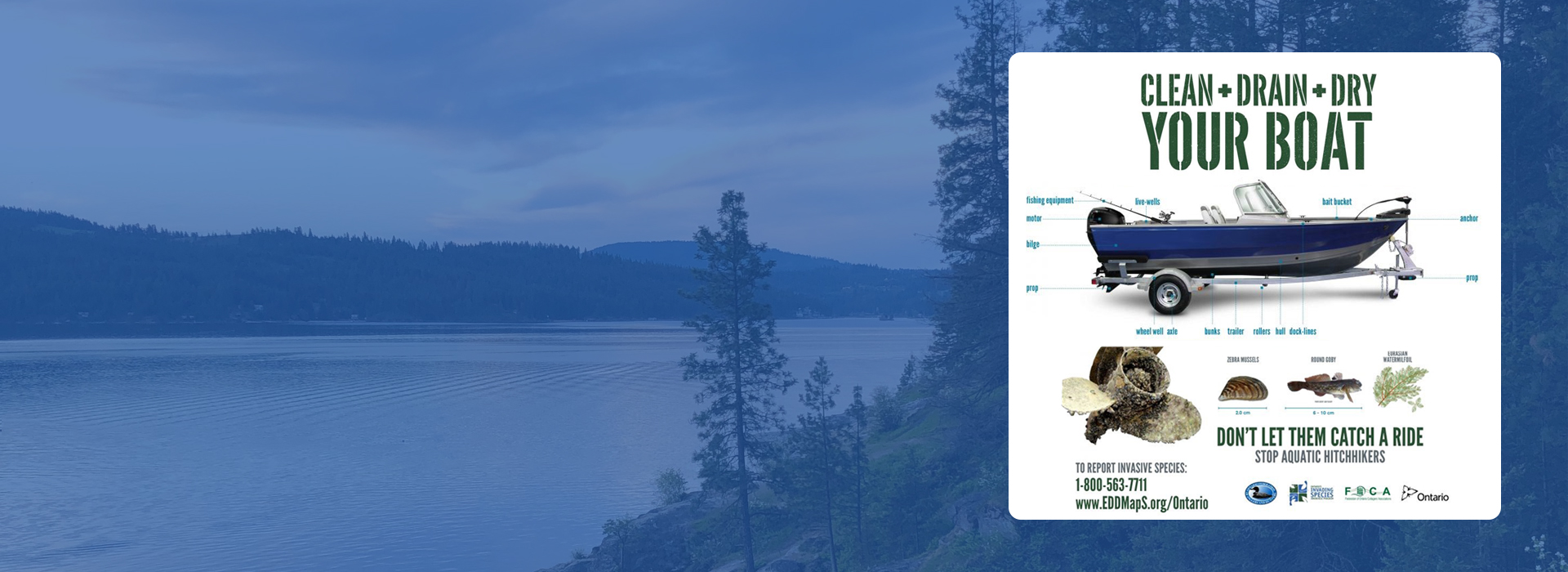
Aquatic invasive species are the single greatest preventable threat to our lakes — and they travel by boat. Zebra mussels, spiny water flea, Eurasian watermilfoil and other invaders hitch rides in bilge water, live wells and bait buckets, and cling to hulls, trailers, anchors, ropes and paddles. Once an invasive species establishes in a lake, there is no practical way to remove it. Prevention is the only cure.
It's the law in Ontario
Since January 1, 2022, watercraft — including canoes and kayaks — are regulated as carriers of invasive species under Ontario's Invasive Species Act. Before transporting any watercraft overland you must remove aquatic plants, animals and algae from the boat, trailer and equipment, and pull drain plugs so all water drains out. Conservation officers can inspect boats and issue fines. Details: Ontario's Invading Species Awareness Program — Boating.
Yes — even between our own lakes
Clean, drain and dry applies when you move a boat between individual lakes, even within our own watershed. Redstone, Little Redstone, Pelaw, Bitter, Long (Tedious), Burdock and Coleman are distinct ecosystems: an invader present in one is not necessarily in the others, and a single trailer ride or portage can change that permanently. If your boat leaves one lake and enters another — even just across the road — treat it as a fresh arrival: clean it, drain it, dry it.
Renting a boat, or bringing one from out of town?
Boats arriving from other regions are the highest-risk pathway into our lakes. Zebra mussels are established in many Kawartha and southern Ontario waters, and spiny water flea is already in a number of Haliburton-area lakes.
- If you rent: ask the rental provider directly whether the boat was cleaned, drained and dried after its last outing. Many rental fleets move between lakes weekly, and the provider may not have done the work our lakes depend on. If they can't answer, do it yourself before launching.
- If you bring a boat from home (the Kawarthas, Muskoka, Lake Simcoe, the Great Lakes): assume it is carrying something. Give it a thorough wash and a minimum of five days' dry time before it touches our water.
What we're keeping out
- Zebra mussels — encrust docks, intakes, hulls and rocks, and strip the plankton that young fish depend on. Our soft Canadian Shield water (naturally low in calcium) makes life harder for them, but that is a head start, not immunity — and it does nothing against the other invaders below.
- Spiny water flea — a tiny crustacean that fouls fishing lines and competes with native fish for food; already found in lakes near Haliburton. Microscopic eggs travel in a single drop of water.
- Eurasian watermilfoil — forms dense mats that choke swimming areas and out-compete native plants; spreads from a single stem fragment on a prop or trailer.
- Round goby and rusty crayfish — aggressive invaders spread through bait buckets and bilge water. Never move bait between waterbodies (our zone's bait rules prohibit it), and never dump a bait bucket in the lake.
The routine
- CLEAN — inspect the boat, trailer, and every piece of gear. Remove all plants, mud and organisms. Rinse away from the water's edge, ideally with hot or pressurized water.
- DRAIN — pull the transom plug, empty the bilge, live well, bait buckets and motor on dry land before you leave the launch area.
- DRY — towel off, then let everything dry in the sun, ideally five days or more, before entering different water. Nothing survives a good drying.
See something suspicious in the lake? Report it to the Invading Species Hotline: 1-800-563-7711 or at EDDMapS Ontario — and let the association know at [email protected].